
In 2026, you cannot afford climate risk messaging that reads like a weather report. The pressure is real, because there is a 97% probability El Niño conditions will persist through early spring 2027, meaning your stakeholders need plans, not paragraphs.

Key Takeaways
| You need to communicate El Niño–driven climate risk in 2026 with | What to do (practical) |
|---|---|
| Clarity | Translate uncertainty into decisions your audience can make right now. |
| Credibility | Use consistent terminology across grants, impact reports, and outreach, so scrutiny does not catch you. |
| Conversion | Write for action, not awards. A report that does not move people does not move the needle. |
| Sustainability fluency | Connect El Niño–driven hazards to your mission, with sustainability-conscious specificity (not vague greenwashing language). |
| Integrated messaging | Treat grant narrative, impact report, and outreach as one story, not three separate documents. |
| Smart support | If you need help, start with a team that understands grant writing, sustainability reporting, and climate risk communication. See our grant writing, impact report, and ESG communications services. |
- What does "El Niño–driven climate risk" mean in 2026 messaging? It means describing likely hazard pathways tied to El Niño, then mapping them to your audience's assets, vulnerable populations, and decision points.
- How do you write a grant narrative climate resilience plan without overpromising? State probabilities, use scenarios, and define concrete actions you will take regardless of the exact outcome.
- How do you keep sustainability copywriting honest? If you cannot prove it in your data, do not claim it in your story.
- Where does "open source" fit? Use open source climate data and methods to strengthen transparency, so your credibility holds up under scrutiny.
1) Start with the decision, not the forecast (because your readers have work to do)
Most climate risk communication fails because it leads with symptoms, not decisions. You do not need more climate doom. You need messaging that turns El Niño uncertainty into operational clarity for the people holding budgets, permits, and public trust.
Here is the tough love version: your website, proposal, and impact report cannot all say "the climate is changing" and call it strategy. Your audience will feel the vagueness and move on.
So begin with a decision frame. For each audience, ask: "What action are they trying to take in 2026?" Then build the message backward.
- For grant reviewers: decisions about funding priorities, implementation feasibility, and measurable outcomes.
- For partners and communities: decisions about preparedness steps, early warning behaviors, and resource access.
- For board and funders (impact report readers): decisions about credibility, accountability, and what you will do next.
When you do this, your copy stops being generic and starts working. Not every writer understands what moves people who actually care, but we do. I've spent 20 years inside the sustainable business world, and the pattern is consistent: clarity beats performance art.
2) Translate uncertainty into probabilities, scenarios, and "what we will do"
El Niño–driven climate risk communication is not about pretending you know the future. It is about being honest about likelihoods, then showing how your plan adapts when conditions shift.
In 2026 super El Niño forecast terms, that means using simple probability language and tying it to action triggers. You can say it plainly without burying the reader in scientific caveats.
A practical structure for 2026 grant narrative climate resilience messaging:
- What conditions are likely: a short "what to expect" summary for the hazard window.
- What could change: a scenario statement (best case, most likely, worst case) without drama.
- What we will do anyway: actions that remain valid across scenarios.
- What we will adjust if conditions change: a clear decision rule for updating interventions.
This is where sustainability reporting and outreach messaging align. The more consistent your scenario language is across documents, the more trust you earn.

3) Build a grant narrative that reviewers can score, not just read
If you want funding in 2026, do not send reviewers on a scavenger hunt. A grant application should function like a product spec. The reader needs evidence, logic, and measurable outputs that connect directly to El Niño–driven hazards.
And yes, you can do this without sounding cold. You just cannot sound vague.
We recommend this grant messaging checklist for climate risk communication:
- Define the hazard pathways: name the linked hazards your work addresses (for example, drought stress, riverine flooding, heat risk).
- State your assumptions: explicitly note which parts of the risk model you are using, including whether you use open source methods.
- Show your implementation readiness: what you already have, what you will build, and how fast.
- Use outcomes that survive scrutiny: outputs that can be verified, and outcomes tied to specific vulnerable groups.
- Write to a scoring rubric: if reviewers value "risk reduction" and "capacity building," then you write those words and prove them with structure.
Did you know? $16,200,000 in estimated program funding is available for the NOAA Regional Integrated Sciences and Assessments (RISA) FY 2026 competition. Source: Grants.gov
That funding pool matters because it changes the game in 2026. Reviewers see more proposals, not fewer, which means your writing quality, evidence density, and clarity will be scrutinized.
This is where copywriting is not optional. Poor copywriting can cost businesses more than $10,000/month through reduced conversion rates and wasted ad spend. In grant land, the cost is missed opportunities.
4) Use impact report storytelling that connects hazards to outcomes (not just activities)
A report that does not move people does not move the needle. And your impact report needs to do two jobs in 2026. First, it needs to prove you acted. Second, it needs to make future partners trust you with risk and resources.
Here is how to write the "El Niño–driven climate risk in 2026" section without turning it into a brochure:
- Lead with the risk you addressed: name the hazard window and the populations affected.
- Show the causal chain: from El Niño–linked conditions to your intervention logic.
- Quantify what changed: describe measurable changes you can defend.
- Include your learning: what you would do differently in the next cycle (credibility builders).
- End with the next decision: "Here is what we will fund and expand next."
If you want sustainability reporting that stays honest, you need a team that treats "copywriting" and "sustainability research reports" as one system. We do that by integrating narrative development with structured evidence, so your report does not become a stack of numbers stakeholders skim and ignore.
If you are evaluating an Impact Report package for 2026, we also offer an Impact Report service (priced at $5,000) and ESG Communications (priced at $3,200) when your reporting needs extend into stakeholder disclosures.
Example language you can adapt:
"In 2026, we addressed El Niño–linked risk to vulnerable households by deploying early warning outreach, targeted service access, and scenario-adjusted preparedness steps. Our outcomes focus on what changed for people, not what we published."
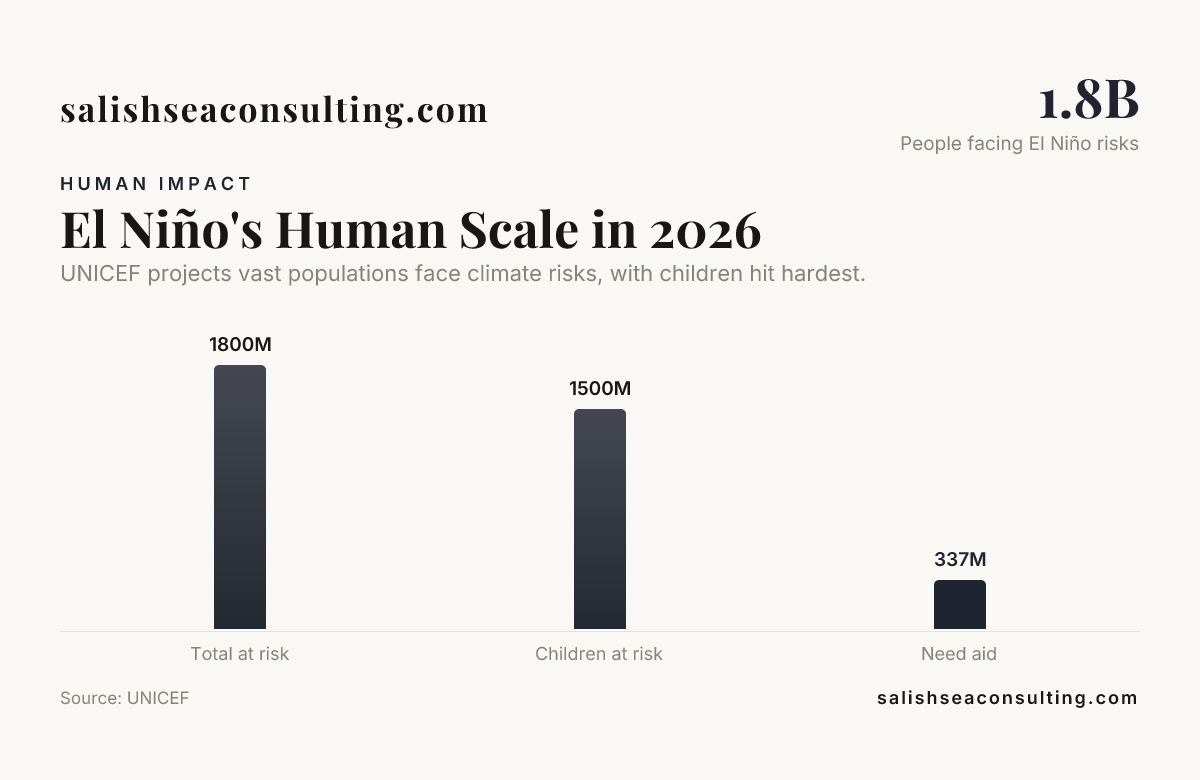
UNICEF projects vast populations face climate risks, with children hit hardest.
5) Outreach messaging: make it actionable, human, and locally usable in 2026
Outreach is where climate risk communication either earns trust or burns it. If your outreach is too technical, people tune out. If it is too general, people panic or ignore it.
In 2026, the best outreach materials do three things well.
- They name the hazard window and timing clearly. People plan around dates, not forecasts.
- They tell you exactly what to do. "If X happens, do Y" beats "Consider being prepared."
- They acknowledge constraints. Mention barriers honestly (cost, access, language) so advice is realistic.
Outreach channels we typically align:
- Community flyers and SMS scripts (short, direct, behavior-focused)
- Partner briefing decks (one slide per decision)
- Web pages that connect to grants and reports (so nothing contradicts)
And yes, this is copywriting. Not generic marketing. Sustainability-conscious communication that respects people's time, attention, and risk realities.

6) Keep the story consistent across grant, report, and outreach (integrated messaging wins)
The copy is generic, the story is vague, and the people you most want to reach leave without acting. That happens when every document is written like it belongs to a different universe.
You need integrated messaging for El Niño–driven climate risk in 2026. That means the same terms, assumptions, and action logic show up everywhere.
Here is the integrated messaging workflow we use in practice:
- Create a single "risk narrative brief" (one page). Include your hazard framing, scenario logic, and decision rules.
- Map the brief to each deliverable: grant narrative climate resilience section, impact report storyline, and outreach behaviors.
- Audit for contradictions: if the grant says "scenario-adjusted," the report must show how you adjusted, and outreach must explain when to switch behaviors.
- Lock your language system: define key phrases so teams stay consistent across drafts.
That integration is what we offer. It is harder to find than either skill alone (writing expertise or sustainability fluency). But if you do not have it, you end up with separate outputs that do not build trust.
7) Budget for quality copywriting and choose a package that fits your 2026 timeline
You do not need more meetings. You need writing quality that gets to the point and holds up under scrutiny. In 2026, the organizations that win are the ones that treat climate risk communication like a mission-critical asset.
Here is what we typically recommend for pricing and scope, using our public service options as a guide:
| Need in 2026 | Best fit (example) | Price reference |
|---|---|---|
| Update your public-facing story for risk, credibility, and actions | Website Bundle | $3,500 |
| Launch an outreach push tied to the hazard window | Launch Package | $2,800 |
| Write grant materials that explain climate risk planning | Power Prospectus or Grant Writing support | $750 (Power Prospectus) and grant writing support available |
| Publish an impact report that strengthens trust | Impact Report | $5,000 |
And if you are wondering whether this overlaps with "SEO writing," here is the truth. Outreach pages, grant landing pages, and report summaries still need to be readable and specific. Sustainability copywriting is not greenwashing patrol, it is building a voice that earns attention because it deserves it.
We do not write fluffy "AI overviews" style summaries. We write for humans who must act. That is the difference.
Did you know? 1.8 billion children globally are exposed to agricultural or meteorological droughts. Source: UNICEF
This stat is not to scare anyone. It is to force better decisions in 2026. If your outreach, grants, and reports do not connect El Niño–driven climate risk to real human exposure, you are not communicating risk. You are describing it.
8) Use open source data and "method transparency" to strengthen trust
In 2026, audiences are tired of polished claims and vague methods. They want to know where the risk framing came from and how you used it to decide what to do.
So bake in method transparency across your documents:
- Reference your data sources clearly: where you got the baseline and how you interpreted it.
- Explain your scenario approach: what you do when conditions diverge from the most likely path.
- Use open source where it strengthens credibility: not because it sounds modern, because it improves transparency and repeatability.
- Keep it consistent: the same "method paragraph" should not contradict itself in a grant and then vanish in the report.
We see this every time we work on sustainability research reports and climate risk communication: the best-performing narratives reduce confusion and prevent skepticism. When you do it right, sustainability stakeholders stop skimming and start engaging.
Conclusion
How to Communicate El Niño–Driven Climate Risk in 2026 (Grant, Report, and Outreach Messaging) is not a writing exercise. It is a decision-making system you apply across every deliverable, so your audience can act with confidence.
Use probabilities and scenarios, write grants that reviewers can score, publish impact reports that connect hazards to outcomes, and run outreach that tells people what to do during the timing window. And if you want it to hold together, treat your grant narrative, impact report, and outreach as one integrated story for 2026, grounded in sustainability and method transparency, supported by strong copywriting (not generic SEO writing or vague AI overviews).
If you want a team that understands grant writing, sustainability reporting, and climate risk communication as one system, we are ready. Start with our services for impact reports, ESG communications, and grant writing, and build a voice that earns trust because it deserves it.
Frequently Asked Questions
How do you communicate El Niño–driven climate risk in 2026 without sounding alarmist? In 2026, you communicate El Niño–driven climate risk by translating uncertainty into probabilities, scenarios, and clear "what we will do" action triggers. The key is honesty plus structure, not fear.
What should a grant narrative climate resilience section include for El Niño planning in 2026? Your section should include hazard pathways, your assumptions, scenario logic, and measurable outcomes tied to El Niño–linked risks. Reviewers look for feasibility, risk reduction, and credibility under scrutiny.
How can an impact report explain El Niño results in 2026 in a way stakeholders will actually read? Write outcomes, not activities. Lead with the risk you addressed, show the causal chain from conditions to interventions, quantify what changed, and end with the next decision.
Is sustainability copywriting the same as greenwashing, and how do we avoid that in 2026? No. Sustainability copywriting is mission-driven and specific. It avoids claims you cannot prove, and it ties language to outcomes. Use transparent methods and consistent terminology across documents.
Should we use open source data in climate risk communication for 2026 outreach? Yes, when it strengthens transparency and repeatability. Open source approaches can help stakeholders trust your method, not just your conclusions.
How do AI overviews and "SEO writing" differ from what we need for El Niño risk messaging in 2026? AI overviews and generic SEO writing often summarize without decision logic. You need action-first copy that connects forecasts to behaviors, timelines, and measurable outcomes.
What is the best way to keep messaging consistent across grants, reports, and outreach in 2026? Create one risk narrative brief and map it to each deliverable, then audit for contradictions. That integrated messaging is what makes your climate risk communication feel coherent and credible across every audience touchpoint.
Salish Sea Consulting helps organizations communicate climate risk with clarity and credibility. If your 2026 messaging needs to connect El Niño–driven hazards to real decisions — in grants, reports, or outreach — let's talk.